

There’s a version of European history most of us absorb through postcards and Instagram grids: the Colosseum as a dramatic backdrop, the Acropolis as a golden-hour photo op, the Eiffel Tower as a symbol of romance. And sure, they’re all of those things. But the real stories behind these landmarks are stranger, messier, and far more interesting than the highlight reel suggests. Knowing the backstory doesn’t just make you sound smart at dinner – it changes the way you experience the place when you’re actually standing in front of it.
The Colosseum Was Almost a Quarry
Rome’s Colosseum opened in 80 AD with a hundred days of games, including (according to some historians) mock naval battles staged by flooding the arena floor. What most visitors don’t realize is how close the building came to disappearing entirely. After the Roman Empire fell, the Colosseum spent centuries as a source of raw materials – its marble facing was stripped for other buildings, its metal clamps pried out and melted down, leaving the pockmarked exterior you see today. It also served as housing, workshops, and even a Christian shrine at various points. The “ancient ruin” tourists photograph is really the leftover skeleton of a building that was continuously repurposed for over a thousand years.
The Acropolis Wasn’t Always White Marble
The Parthenon and its neighboring temples on the Acropolis are often imagined as pristine white stone, a symbol of classical purity. In reality, they were originally painted in vivid reds, blues, and golds, with statues brightly colored to look almost lifelike. The clean white marble aesthetic we associate with “classical” Greece is largely a product of centuries of weathering and, later, 18th and 19th century tastes that preferred the stripped-down look. Archaeologists have found trace pigments on surviving fragments that hint at just how colorful the site once was – a detail that surprises most first-time visitors.
The Eiffel Tower Was Supposed to Be Torn Down
Built for the 1889 World’s Fair, the Eiffel Tower was only ever meant to stand for 20 years. Many Parisian artists and intellectuals hated it, calling it an eyesore and even signing a public petition demanding it be dismantled. What saved it was, somewhat unglamorously, radio technology. The tower’s height made it useful for early wireless telegraphy experiments, and by the time its 20-year permit expired, it had become too valuable as a communications tower to remove. The romantic icon of Paris survived because of military signal transmission, not aesthetics.
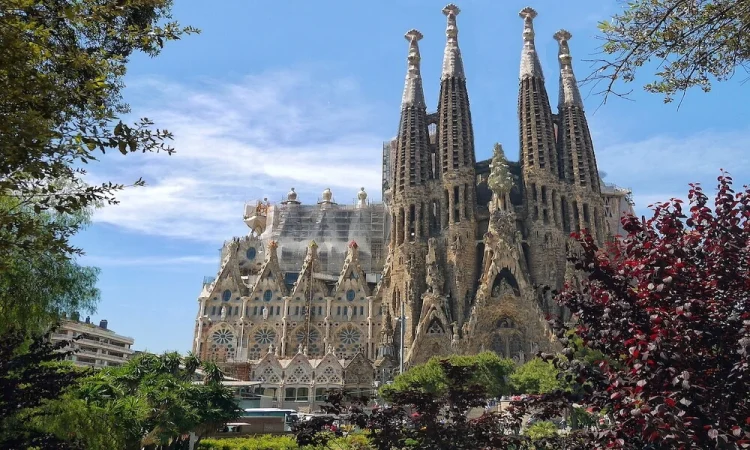
Sagrada Família Has Been Under Construction for Over 140 Years
Antoni Gaudí began work on Barcelona’s Sagrada Família in 1883, and it’s still not finished. Gaudí himself knew he wouldn’t live to see it completed, reportedly saying his client – meaning God – was “not in a hurry.” The project was delayed further by the Spanish Civil War, when anarchists destroyed many of Gaudí’s original models and plans, forcing later architects to reconstruct his vision from fragments and photographs. Current estimates put completion sometime in the coming years, meaning generations of visitors have watched this landmark grow, literally, one visit at a time.
Stonehenge’s Purpose Is Still a Mystery
Unlike the landmarks above, Stonehenge predates written history in Britain, which means there’s no ancient text to tell us definitively why it was built. Theories range from an astronomical calendar to a burial site to a healing center, and modern research using ground-penetrating radar keeps uncovering new structures buried nearby, suggesting the monument was part of a much larger ceremonial landscape. Every few years, a new discovery reshuffles the leading theory, which is part of why it remains one of the most studied – and least understood – sites in Europe.
Why the Backstory Changes the Visit
Standing in front of these landmarks with some context transforms the experience from a photo op into something closer to time travel. Knowing the Colosseum was cannibalized for parts makes its scars readable instead of just visually interesting. Knowing the Parthenon was once brightly painted makes it easier to imagine the site as it actually was, full of color and life, rather than a solemn monochrome ruin. It’s the difference between looking at a landmark and actually seeing it.
This is part of why itineraries that string several of these sites together over land and sea have become so popular – european cruises make it possible to wake up in Rome, spend an afternoon at the Acropolis a few days later, and still have time to wander Barcelona without the logistics of booking flights and hotels between every stop. It turns a bucket list into an actual itinerary.
If you want to go deeper on any of these sites before you go, UNESCO’s World Heritage Centre maintains detailed historical and preservation documentation on most of the landmarks mentioned here, including the Acropolis and Stonehenge: whc.unesco.org.

